I have just launched a second blog at http://tryingtospeakspanish.blogspot.com. As the name suggests it is all about learning Spanish, so although not really related to the content of this site, it is quite relevant to my own career as a ski instructor in a mainly Spanish speaking ski school.
There may well be a little crossover with this site, as the Spanish I have learnt tends to have a bias towards skiing related terms. However for most readers interested in the ski and outdoor focus of this blog, then unless you have an interest in learning Spanish as well then there might not be that much to interest you, so I won't take it to personally if you decide not to spend any time there.
Having said that, I thought I should mention it, just in case regular readers are interested in what else I am getting up to online, or in case you noticed a new blog appear in my profile and wondered what it was about.
The new blog will probably have more regular posts than this one, but shorter ones. I imagine it will have less photos as well, as I take plenty of photographs of mountains but far fewer of anything very typically Spanish.
If there are any other skiers out there who want to learn Spanish as well then please leave a comment and let me know what you think so far. For the rest of you, I promise to get back to some skiing in the next post.
Tuesday, 19 April 2011


Tuesday, 12 April 2011
Three Cols Tour (Les Trois Cols)
Following on from the EMS course mentioned in the last post, we have to log a number of days ski touring before taking the exam course. My first tour following the course was the 3 Cols route in the Chamonix valley. This starts from the Grand Montets cable car (or the Argentiere refuge), descends to cross the Argentiere glacier before climbing to the Col du Chardonnet, a rappel down and a ski and skin lead to the Fenetre du Saleina and Col Superior du Tour, before skiing down to Le Tour village. This was a full day out, with 1200m of ascent and some really spectacular scenery. Thanks to Sandra for a great day.


Wednesday, 6 April 2011
EMS - Mountain Safety Training
In the past I have mentioned the Eurotest and how it can be a major hurdle for ski instructors wanting to work in France. The French have also imposed a second test - the Eurosecurity - which is now part of the top level qualifications for Eurogroup countries including France, Italy, Austria and the UK. Whilst less known and for most people less difficult than the Eurotest the Eurosecurity course is a lot more useful and practical for working ski instructors. The idea is to achieve a minimum standard of mountain safety awareness so that clients can be confident that a top level qualified instructor is competent to take them off piste safely.

I have just attended the training part of the Eurosecurity or EMS (European Mountain Safety) as it is named in the British system. The second part will be a three day examination next winter in La Grave. The photo above is from the first day of the course, ascending the Col des Crochues in the Chamonix Aiguilles Rouge range.

The second and third days of the course took us to the region around the Grand St. Bernard Pass which links Switzerland and Italy (above - setting off from the Super St. Bernard car park; below - arriving at the St. Bernard Monastery where we spent the night.)


Overall I have to say that this was one of the best of the many ski instructor courses I have done. It was definitely one of the most enjoyable, partly because there was no exam - not until next year anyway - and partly because we got to explore a lot more of the mountains than on most courses. It was also a very useful course. I often ski off piste with clients in a fairly limited way, within the remit of my current ISIA Mountain Safety qualification i.e. within the ski area, close to marked runs, accessible from ski lifts.
"Can we go off-piste?" is a common question from my more advanced groups whilst "Can we learn to race?" is something I almost never hear. However skiing off piste entails all the risks of the mountain environment - avalanches, navigation hazards, rocks, cliffs, trees etc. so it is important for the instructor to be aware of the risks and to work within the remit of their qualifications to minimise them. An instructor who has passed the Eurosecurity is then qualified to take clients off piste or ski-touring on non-glaciated terrain for up to one day. For trips beyond the remit of this qualification the client would have to book a UIAGM/IFAMG qualified High Mountain Guide.

I have just attended the training part of the Eurosecurity or EMS (European Mountain Safety) as it is named in the British system. The second part will be a three day examination next winter in La Grave. The photo above is from the first day of the course, ascending the Col des Crochues in the Chamonix Aiguilles Rouge range.

The second and third days of the course took us to the region around the Grand St. Bernard Pass which links Switzerland and Italy (above - setting off from the Super St. Bernard car park; below - arriving at the St. Bernard Monastery where we spent the night.)


Above - St Bernard Pass. Below - Day 3, ski touring in Italy and Switzerland


Overall I have to say that this was one of the best of the many ski instructor courses I have done. It was definitely one of the most enjoyable, partly because there was no exam - not until next year anyway - and partly because we got to explore a lot more of the mountains than on most courses. It was also a very useful course. I often ski off piste with clients in a fairly limited way, within the remit of my current ISIA Mountain Safety qualification i.e. within the ski area, close to marked runs, accessible from ski lifts.
"Can we go off-piste?" is a common question from my more advanced groups whilst "Can we learn to race?" is something I almost never hear. However skiing off piste entails all the risks of the mountain environment - avalanches, navigation hazards, rocks, cliffs, trees etc. so it is important for the instructor to be aware of the risks and to work within the remit of their qualifications to minimise them. An instructor who has passed the Eurosecurity is then qualified to take clients off piste or ski-touring on non-glaciated terrain for up to one day. For trips beyond the remit of this qualification the client would have to book a UIAGM/IFAMG qualified High Mountain Guide.
Sunday, 27 February 2011
Ignore the Snow Reports
Many a UK skier spends the winter months avidly scanning the snow reports, either to decide where to book a skiing trip to, or to try and figure out what the snow will be like when they arrive at their destination.
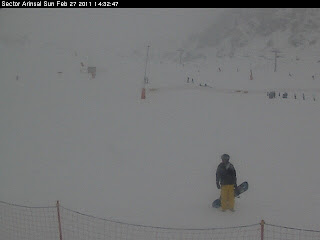
The trouble with snow reports is that things change, often quickly. A lot of snow can fall over a day or two, meaning that those pessimistic reports from the week before are quickly out of date. Compare these photos of Arinsal (one from my window and one Vallnord Webcam image) to the sunny photos of my last post for example.

The other problem with snow reports is that the numbers are not that relevant. People often say things like "Resort X has 150cm of snow and Resort Y only has 90cm, so Resort X is better this year." I have to say that as long as any rocks are covered I have never noticed the difference between skiing over 20cm or 200cm of snow depth on the pistes. Even if it did matter, the snow depth changes constantly as the ground underneath is not flat, and the snow is moved by both the wind and the piste grooming machines. The biggest factor that determines the snow depth measured is where exactly the measuring stick is pushed into the ground. Each resort will use the same spot for their measurements, so it is fair to compare this winter to last winter, or this week to last, in the same resort. Trying to compare different resorts based on snow depth is pretty meaningless though. The cumulative snowfall for the season - i.e. how much snow has fallen - might be a more useful figure to compare resorts for their snowiness. This will be a much bigger number than the snow depth as the light fluffy snow that falls will compact into dense heavy snow over time.
If you live close to a ski area, or a few of them, looking at the snow reports on a daily basis when deciding where to go and what to do is definitely a good idea. If you live here in Andorra for example you have plenty of options for your weekend skiing. If you live in the UK then the Scottish reports are the only ones really worth looking at outside of your holiday. Looking at the reports during your holiday is a good idea as well, particularly if you plan to go off piste. Looking at the reports in advance though is often just going to make you pessimistic ahead of what will probably out to be a great holiday.
The final point I want to make on this is that snowmaking technology has come a long way in the last few years. Here in Arinsal for example, almost every run (95% of the ski area) has been open all season despite a sunny January and early February with a lot less snow that average. Not only have the pistes been open, they have been well maintained and kept in good condition the entire season. For beginners, many intermediates and in fact anybody who prefers to ski on-piste to off, the conditions have been every bit as good as in a really snowy year with the added bonus of being able to ski in the sunshine most of the time. The only disadvantage is that the (fantastic) view across Andorra is a bit greener than people have been expecting.
The trouble with snow reports is that things change, often quickly. A lot of snow can fall over a day or two, meaning that those pessimistic reports from the week before are quickly out of date. Compare these photos of Arinsal (one from my window and one Vallnord Webcam image) to the sunny photos of my last post for example.


The other problem with snow reports is that the numbers are not that relevant. People often say things like "Resort X has 150cm of snow and Resort Y only has 90cm, so Resort X is better this year." I have to say that as long as any rocks are covered I have never noticed the difference between skiing over 20cm or 200cm of snow depth on the pistes. Even if it did matter, the snow depth changes constantly as the ground underneath is not flat, and the snow is moved by both the wind and the piste grooming machines. The biggest factor that determines the snow depth measured is where exactly the measuring stick is pushed into the ground. Each resort will use the same spot for their measurements, so it is fair to compare this winter to last winter, or this week to last, in the same resort. Trying to compare different resorts based on snow depth is pretty meaningless though. The cumulative snowfall for the season - i.e. how much snow has fallen - might be a more useful figure to compare resorts for their snowiness. This will be a much bigger number than the snow depth as the light fluffy snow that falls will compact into dense heavy snow over time.
If you live close to a ski area, or a few of them, looking at the snow reports on a daily basis when deciding where to go and what to do is definitely a good idea. If you live here in Andorra for example you have plenty of options for your weekend skiing. If you live in the UK then the Scottish reports are the only ones really worth looking at outside of your holiday. Looking at the reports during your holiday is a good idea as well, particularly if you plan to go off piste. Looking at the reports in advance though is often just going to make you pessimistic ahead of what will probably out to be a great holiday.
The final point I want to make on this is that snowmaking technology has come a long way in the last few years. Here in Arinsal for example, almost every run (95% of the ski area) has been open all season despite a sunny January and early February with a lot less snow that average. Not only have the pistes been open, they have been well maintained and kept in good condition the entire season. For beginners, many intermediates and in fact anybody who prefers to ski on-piste to off, the conditions have been every bit as good as in a really snowy year with the added bonus of being able to ski in the sunshine most of the time. The only disadvantage is that the (fantastic) view across Andorra is a bit greener than people have been expecting.
Saturday, 12 February 2011
Spring (???) hill walking photos
It isn't exactly the hill walking season here in Andorra, but with unseasonably warm temperatures, sunshine, and receding snowlines on the south facing slopes (still plenty of snow on the ski pistes though) I decided to take a walk up the hillside behind our appartment building. Partly because I have always been curious to have a closer look at the bordes (farm buildings) which perch on the hillside opposite the ski area, and partly because I rarely get the chance to go out walking during the ski season, with being on skis pretty much every day.
For those interested in walking the Andorran mountains, and seeing a quiter side of the country away from the ski areas and tax free shopping, there is a very good Cicerone Guidebook - The Mountains of Andorra: Walks, Scrambles, Via Ferratas and Treks which covers the entire country (it is quite a small country so there is plenty of detail). Unfortunately getting a decent map of the area is not so easy, as none published here are very up to date or accurate. The 1:25000 map published by the government stops at the border, with adjacent parts of Spain and France left as white space - looking at it one half expects to see "Here be dragons" scrawled across the edges of the map.
Here are a few photographs to show you a side of Andorra not often seen by visitors to the ski resorts.
For those interested in walking the Andorran mountains, and seeing a quiter side of the country away from the ski areas and tax free shopping, there is a very good Cicerone Guidebook - The Mountains of Andorra: Walks, Scrambles, Via Ferratas and Treks
which covers the entire country (it is quite a small country so there is plenty of detail). Unfortunately getting a decent map of the area is not so easy, as none published here are very up to date or accurate. The 1:25000 map published by the government stops at the border, with adjacent parts of Spain and France left as white space - looking at it one half expects to see "Here be dragons" scrawled across the edges of the map.Here are a few photographs to show you a side of Andorra not often seen by visitors to the ski resorts.
 |
| Les Marades piste (left) and Coma Pedrosa - 2939m (right) |
 |
| Bordes Del Torner |
 |
| Bordes de Prats Nous |
 |
| Pal and Arinsal ski areas |
 |
| Coma Pedrosa valley with Coll Carnisser in foreground |
 |
| Bordes de Percanela |
Tuesday, 1 February 2011
Video Review - Steep
This skiing documentary is currently being sold on Amazon UK with my all time favourite ski movie - "The Blizzard of Ahhhs" thrown in as a bonus. If you don't already own either you have a good opportunity to get hold of both for £12.99. Since I recently watched "Steep" for the first time, it seems an ideal moment to post this blog's first ever video review.


I should begin by pointing out that "Steep" is not your typical ski movie. If you are expecting the usual adrenaline fueled mix of high speed, big air, steep powderfields and avalanche dodging - all set to a banging soundtrack - then you might be disappointed. There is still plenty of adrenaline, powder skiing and inspiring descents, but on the whole, this is a much more considered affair tracing the history of extreme skiing from its beginnings around forty years ago to the present day. As inspiring as the action sequences are, I found the interviews with the protagonists more captivating and interesting. The risks of the sport are not ignored but tackled head on. In fact a large part of the film attempts to unravel what drives these people to risk their lives in pursuit of another epic ski descent.
Beginning with Bill Briggs climbing and skiing the Grand Teton in 1971, the story moves between North America and Europe as it follows various pioneers of the sport and the developments brought by each decade, ending with the heroes of the last decade. It is sobering to note that many of the skiers featured are no longer alive. Particularly moving are the interviews with the late Doug Combs and his wife, where they talk candidly about the possiblity of him dying in the mountains, doing what he loves.
As well as covering the risks though, the film also brings across the passion for the mountains and the zest for life that the heroes of the sport invariably have.
On Amazon UK, "Steep" is being sold as a two disc set with the classic late 80s ski movie "The Blizzard of Ahhs". This is the film that launched the career of Glen Plake - owner of the most famous mohican in skiing. Filmed and narrated by Greg Stump, it follows Scott Schmitt, Mike Hatrup and Glen Plake as they travel from the US to Chamonix, France, to ski the extreme. It is a great companion to "Steep", as the latter film looks in detail at "Blizzard", and its place in the development of extreme skiing.
I should begin by pointing out that "Steep" is not your typical ski movie. If you are expecting the usual adrenaline fueled mix of high speed, big air, steep powderfields and avalanche dodging - all set to a banging soundtrack - then you might be disappointed. There is still plenty of adrenaline, powder skiing and inspiring descents, but on the whole, this is a much more considered affair tracing the history of extreme skiing from its beginnings around forty years ago to the present day. As inspiring as the action sequences are, I found the interviews with the protagonists more captivating and interesting. The risks of the sport are not ignored but tackled head on. In fact a large part of the film attempts to unravel what drives these people to risk their lives in pursuit of another epic ski descent.
Beginning with Bill Briggs climbing and skiing the Grand Teton in 1971, the story moves between North America and Europe as it follows various pioneers of the sport and the developments brought by each decade, ending with the heroes of the last decade. It is sobering to note that many of the skiers featured are no longer alive. Particularly moving are the interviews with the late Doug Combs and his wife, where they talk candidly about the possiblity of him dying in the mountains, doing what he loves.
As well as covering the risks though, the film also brings across the passion for the mountains and the zest for life that the heroes of the sport invariably have.
On Amazon UK, "Steep" is being sold as a two disc set with the classic late 80s ski movie "The Blizzard of Ahhs". This is the film that launched the career of Glen Plake - owner of the most famous mohican in skiing. Filmed and narrated by Greg Stump, it follows Scott Schmitt, Mike Hatrup and Glen Plake as they travel from the US to Chamonix, France, to ski the extreme. It is a great companion to "Steep", as the latter film looks in detail at "Blizzard", and its place in the development of extreme skiing.
Thursday, 6 January 2011
How to be good (at skiing)
To follow on from the last post about how long it takes to get good at skiing, here are a few thoughts on how to get there.
Firstly, to get really good you need to ski regularly. As it takes many weeks of skiing to get to a level most people would consider to be good, a single week's holiday a year will get you there very slowly. Leaving a whole year between each time you ski also gives you a long time to get out of practice. If you are going to spend more time skiing each year, it makes sense to spread that time around the season, or even the whole year, as much as possible. That way you will have less time to forget between each visit to the slopes.
Consider a second holiday in the winter, maybe to a cheaper resort, or a long weekend ski break as well as a week's holiday. If you are lucky enough to live within an easy drive of a ski area, even a small one, then take advantage of that and go there as often as you can. The cheaper local ski centres are ignored by many in favour of saving up for a big trip to a big name resort, but each has its own unique offering which may be well worth a visit.
If you cannot manage a visit to the mountains then artificial slopes can help keep your skiing on form. A few visits before your ski holiday will get your ski legs back so that you hit the pistes in good form on the first day of the holiday. Most artificial slopes will have clubs with regular coaching sessions so you can keep improving your skiing throughout the year.
Two of the best options to extend your annual ski time are to live in a ski resort for a season, and to get at least some skiing in during the summer months. There are many ways to do a ski season, be it working in resort, or funding yourself to take a year out, but those can wait until a future post as it is a bit late for this season and early for next. Having said that, it is always worth asking around when you are in a resort this year if you want to organise something for next winter, and there may even be vacancies where people have left the resort for some reason.
Skiing during the summer months is a fantastic way to improve, as you will at least halve the gap between your skiing trips. There are many options from this ranging from a few hours on an artificial slope, through a week or two at a resort with summer skiing up to doing a whole season in the opposite hemisphere.

As well as increasing the time spent on skis, your rate of improvement depends a lot on what you do with that time. I am a firm believer in lessons or coaching in order to improve your skills, as practice alone can only take you so far. Skiers at any level from beginners to world champions benefit from coaching. This does not mean you have to book into ski school for a week. If you already know how to ski then an hour or two with an instructor to fine tune your technique and get an idea of what to work on can be very productive. If you are at a high level then there are many performance skiing courses you can take to improve your skiing in specific areas, be it recreationally or as a competitor.
Lastly, you can improve much faster if you approach all your skiing with this as your goal. Many skiers spend their time cruising about the same pistes, never challenging themselves, spending as much time on lunches and coffee breaks as they do on skiing. There is absolutely nothing wrong with this - it is a very pleasant way to spend time in a beautiful environment, and holidays are supposed to be enjoyable after all. However you will improve faster if you constantly challenge yourself. Ski challenging runs or ski faster (always with respect for other slope users of course). Try to make every turn a good one. On easy slopes set yourself challenges - ski on one ski or do some other exercise, try not to allow the ski to skid, try to make a set number of turns in a given length of piste, or restrict yourself to skiing in a certain corridor. There are many things you can do to push yourself, but it is very easy to let your skiing stagnate if you don't do them.
Firstly, to get really good you need to ski regularly. As it takes many weeks of skiing to get to a level most people would consider to be good, a single week's holiday a year will get you there very slowly. Leaving a whole year between each time you ski also gives you a long time to get out of practice. If you are going to spend more time skiing each year, it makes sense to spread that time around the season, or even the whole year, as much as possible. That way you will have less time to forget between each visit to the slopes.
Consider a second holiday in the winter, maybe to a cheaper resort, or a long weekend ski break as well as a week's holiday. If you are lucky enough to live within an easy drive of a ski area, even a small one, then take advantage of that and go there as often as you can. The cheaper local ski centres are ignored by many in favour of saving up for a big trip to a big name resort, but each has its own unique offering which may be well worth a visit.
If you cannot manage a visit to the mountains then artificial slopes can help keep your skiing on form. A few visits before your ski holiday will get your ski legs back so that you hit the pistes in good form on the first day of the holiday. Most artificial slopes will have clubs with regular coaching sessions so you can keep improving your skiing throughout the year.
Two of the best options to extend your annual ski time are to live in a ski resort for a season, and to get at least some skiing in during the summer months. There are many ways to do a ski season, be it working in resort, or funding yourself to take a year out, but those can wait until a future post as it is a bit late for this season and early for next. Having said that, it is always worth asking around when you are in a resort this year if you want to organise something for next winter, and there may even be vacancies where people have left the resort for some reason.
Skiing during the summer months is a fantastic way to improve, as you will at least halve the gap between your skiing trips. There are many options from this ranging from a few hours on an artificial slope, through a week or two at a resort with summer skiing up to doing a whole season in the opposite hemisphere.

Summer race training camp in Les 2 Alpes
Spreading ski training over the year
Spreading ski training over the year
As well as increasing the time spent on skis, your rate of improvement depends a lot on what you do with that time. I am a firm believer in lessons or coaching in order to improve your skills, as practice alone can only take you so far. Skiers at any level from beginners to world champions benefit from coaching. This does not mean you have to book into ski school for a week. If you already know how to ski then an hour or two with an instructor to fine tune your technique and get an idea of what to work on can be very productive. If you are at a high level then there are many performance skiing courses you can take to improve your skiing in specific areas, be it recreationally or as a competitor.
Lastly, you can improve much faster if you approach all your skiing with this as your goal. Many skiers spend their time cruising about the same pistes, never challenging themselves, spending as much time on lunches and coffee breaks as they do on skiing. There is absolutely nothing wrong with this - it is a very pleasant way to spend time in a beautiful environment, and holidays are supposed to be enjoyable after all. However you will improve faster if you constantly challenge yourself. Ski challenging runs or ski faster (always with respect for other slope users of course). Try to make every turn a good one. On easy slopes set yourself challenges - ski on one ski or do some other exercise, try not to allow the ski to skid, try to make a set number of turns in a given length of piste, or restrict yourself to skiing in a certain corridor. There are many things you can do to push yourself, but it is very easy to let your skiing stagnate if you don't do them.
Subscribe to:
Posts (Atom)
